
Cycling
Power Meter Data: Ultimate Guide to FTP, NP and TSS
PUBLISHED: 2026-08-10|READ TIME: 5 MINS|AUTHOR: FRANCESCO CASTALDI
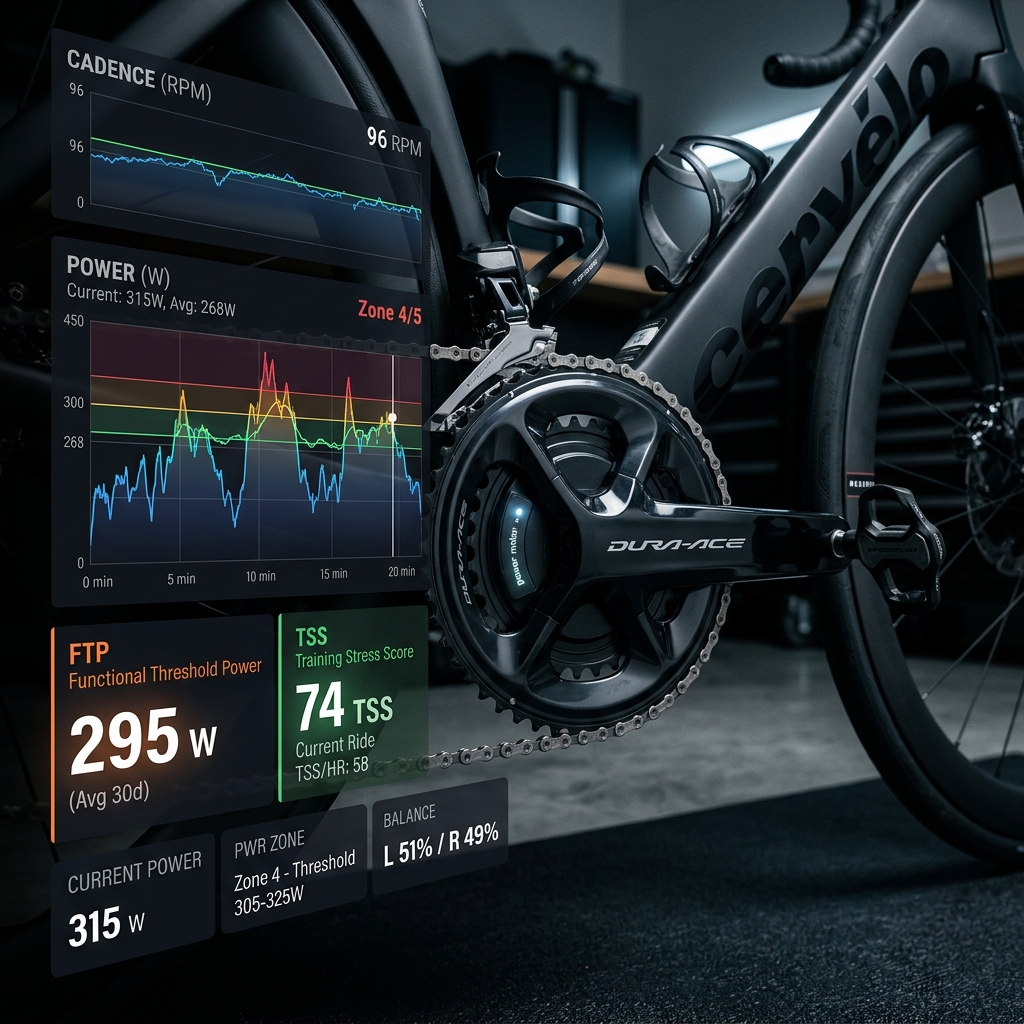
FIGURE: Power Meter Data Analysis
Beyond Heart Rate
For decades, cyclists relied on heart rate monitors. But the heart lies: it is affected by heat, stress, caffeine, and sleep. Power on the pedals, measured in Watts, is an objective and undeniable data point.
Measuring power is useless if you don't know how to read the three fundamental metrics.
[ IMPORTANT ]
Before using these metrics, you must perform an FTP (Functional Threshold Power) test, typically a 20-minute maximal test, to calculate your threshold Watts.
The Three Key Metrics
| Metric | Acronym | Meaning | Practical Use |
|---|---|---|---|
| Functional Threshold Power | FTP | The maximum sustainable power for about 1 hour. | Baseline parameter to calculate training zones (Z1-Z7). |
| Normalized Power | NP | Estimate of the power you would have maintained if the effort were perfectly steady. | Evaluates the real metabolic cost of races with many sprints (e.g., criteriums). |
| Training Stress Score | TSS | Score quantifying the total workload of the session. | A TSS of 100 is equivalent to 1 hour riding all-out at your FTP. Used to program recovery. |
How to Avoid Overtraining
Many amateurs only look at Average Power. This is a fatal mistake on hilly routes. Always use *Normalized Power* to understand how tired you really are. If your weekly TSS exceeds 700 without an adequate base, you are entering the overtraining zone.