TPER website redesign
A user experience redesign of the Bologna public transport website, following the Double Diamond process from user research to a 22 page interactive prototype.
- Role
- Team member, TperTutti team
- When
- July 2026
- Course
- User Experience Design
- Stack
- User research, Usability testing, HTML, CSS, JavaScript, LaTeX
Context
TPER runs buses and trains in Bologna and across Emilia-Romagna. Its website is where people plan trips, buy tickets and renew subscriptions, and it serves a very mixed audience: commuters, students, tourists and many older people. For the User Experience Design course, our team (TperTutti) redesigned it following the Double Diamond process: discover, define, develop, deliver.
Process
Discover. We tested the existing site with four participants on realistic tasks, measuring completion, time, errors and the System Usability Scale (SUS).
Define. From the findings we wrote four personas, usage scenarios and thirteen design recommendations.
Develop. We reorganised the information architecture, drew blueprints of the service ecosystem and user journey, built seven wireframes and documented five before and after comparisons.
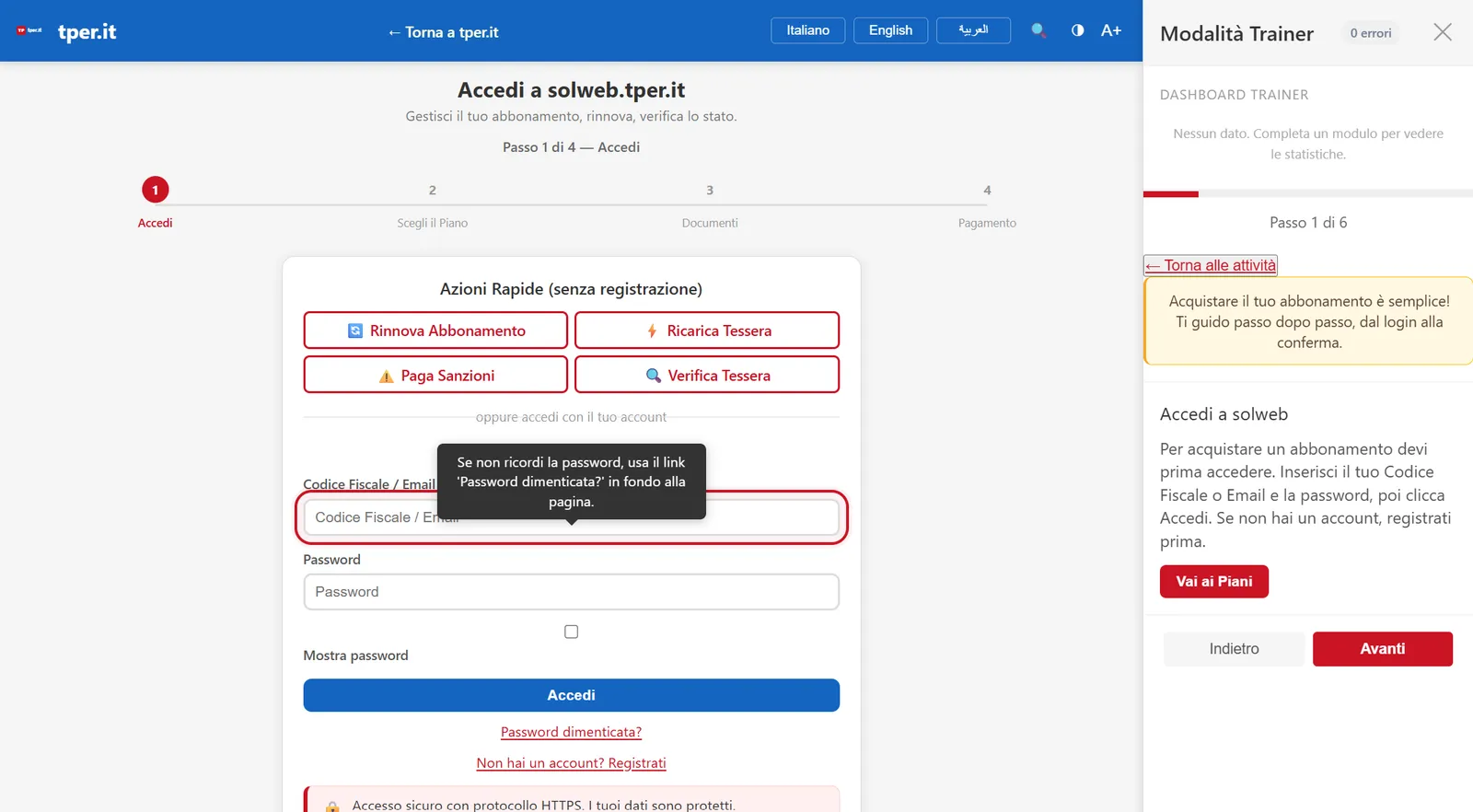
Deliver. We built a clickable prototype of 22 pages in plain HTML, CSS and JavaScript: trip planner, tickets and prices, subscriptions with a guided wizard, discount eligibility checker, timetables, and a logged in area for payments, renewals and document uploads. The prototype supports Italian, English and Arabic. We then evaluated it with a cognitive walkthrough, two formative tests and two summative tests.
Trainer Mode
The central idea of the redesign is Trainer Mode: an optional overlay that walks the user through a complex task step by step (buying a ticket, renewing a subscription, planning a trip), highlighting the next thing to click. It targets users who are not comfortable with web forms, without making the site slower for everyone else.
Results
The test groups were small, as is common in course projects, so these numbers indicate direction rather than prove an effect. On the original site, participants completed 6 of 20 tasks and the average SUS score was 37.5. On the prototype, the summative tests reached an average SUS of 72.5 (above the commonly used benchmark of 68), and one representative task dropped from 195 seconds with seven errors to 57 seconds with none.
The full project report (about 125 pages, in Italian and English) is in the repository, written in LaTeX.